---
title: Service Authentication — Zero-Trust Architecture
---
# Service Authentication — Zero-Trust Architecture
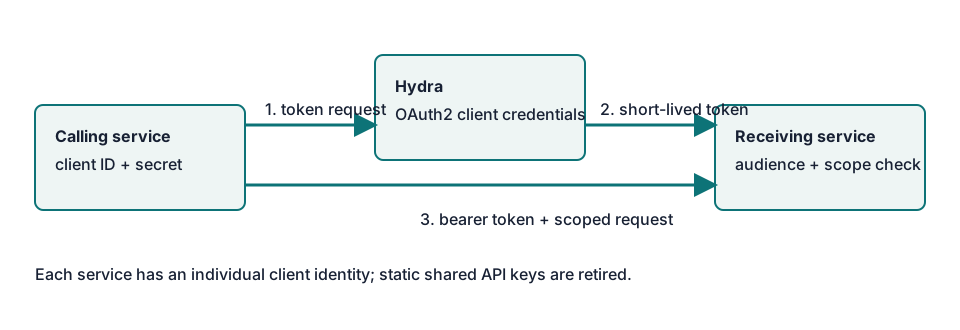
Service-to-service OAuth2 client-credentials flow. Download SVG source
> **Current state as of 2026-06-18.** Deployed on `feat/auth-zero-trust`. Covers service-to-service
> (s2s) auth only. User-facing auth (browser login, JWT bearer, Oathkeeper) is described in
> [N1 landscape](/landscape/).
---
## What changed and why
Previously every backend service that called another N1 service passed a static pre-shared secret
in a custom `N1-Api-Key` HTTP header. The receiving service compared the incoming value against a
secret loaded from the pod environment at startup. That model has three hard problems:
1. **No per-service identity.** Every service shared the same secret; a leak anywhere compromised
everything. There was no way to know which service made a given call.
2. **No scope enforcement.** Any holder of the static key could call any endpoint — a parser
had the same access as the forge orchestrator.
3. **No short-lived credentials.** Rotating the key meant coordinating a simultaneous restart of
every service that held it.
The new model gives every backend service its own Hydra OAuth2 client identity, issues short-lived
Bearer tokens via the `client_credentials` grant, and enforces named scopes at the receiving
endpoint. The static `N1-Api-Key` header and `N1_API_KEY` env var no longer exist on the
service-to-service path.
---
## How it works
### Token acquisition
A service that needs to call another N1 service:
1. Reads `HYDRA_URL`, `HYDRA_CLIENT_ID`, `HYDRA_CLIENT_SECRET` from its pod environment (injected
via External Secrets from AWS Secrets Manager).
2. Posts to `http://hydra-public:4444/oauth2/token` with HTTP Basic auth and
`grant_type=client_credentials`.
3. Receives a short-lived opaque access token (default 1 hour, controlled by Hydra's
`access_token.lifespan` setting).
4. Caches the token in memory until 60 seconds before expiry, then re-fetches.
```
Service A Hydra public
│ │
├─ POST /oauth2/token ──────────────────────▶ │
│ Basic n1-auth-svc: │
│ grant_type=client_credentials │
│ ◀────┤
│ {"access_token": "...", "expires_in": 3600}
│
│ (cache token in memory until expiry - 60s)
```
### Token presentation
The calling service sets the token on outbound HTTP requests:
```
Authorization: Bearer
```
No custom headers. No `N1-Api-Key`.
### Token verification (acceptor side)
The receiving service calls Hydra admin directly — not through Oathkeeper — to introspect the
token:
```
Service B Hydra admin
│ │
├─ POST /admin/oauth2/introspect ──────────▶ │
│ token= │
│ ◀────┤
│ {"active": true, "client_id": "n1-forge-sentinel-svc",
│ "scope": "reports:read records:read billing:write", ...}
│
├── check: active == true
├── check: required scope present
└── proceed (or 403)
```
On HTTP 401 from the downstream service, the caller invalidates its token cache and fetches a
fresh token before retrying once. This handles the case where a token was revoked or Hydra was
restarted.
---
## Client registry
Every service that calls another N1 service has a registered Hydra client. Clients are provisioned
by the `hydra-client-provisioner` Helm chart, which runs as a one-shot Kubernetes Job on
install/upgrade and upserts each client via the Hydra admin API. Secrets are stored in AWS Secrets
Manager at `{env}-cluster/hydra-clients/{clientId}` and pulled into the pod by External Secrets
Operator.
| Client ID | Service | Scopes | Calls |
|---|---|---|---|
| `n1-auth-svc` | authentication-service | `profile:read profile:write records:read billing:read billing:write` | api-backend, billing-service |
| `n1-api-backend-svc` | api-backend | `profile:read profile:write records:read records:write reports:read reports:write billing:read billing:write` | authentication-service, billing-service |
| `n1-billing-svc` | billing-service | `profile:read` | authentication-service |
| `n1-ws-proxy-svc` | api-websocket-proxy | `profile:read` | api-backend |
| `n1-parser-router-svc` | parser-router | `records:read records:write` | api-backend |
| `n1-parser-sequential-svc` | parser-sequential | `records:read records:write genetics:write` | api-backend |
| `n1-rosetta-grouper-svc` | rosetta-grouper | `records:read records:write` | api-backend |
| `n1-helix-parser-svc` | helix-parser | `records:read genetics:read genetics:write` | api-backend |
| `n1-data-validation-svc` | data-validation-service | `records:read` | api-backend |
| `n1-forge-sentinel-svc` | forge-sentinel | `reports:read reports:write records:read billing:read billing:write` | api-backend, billing-service |
| `n1-forge-runner-svc` | forge-runner / workflow-* | `reports:read reports:write records:read genetics:read` | api-backend |
| `n1-admin-dashboard-svc` | admin-dashboard | `profile:read profile:write records:read records:write reports:read reports:write billing:read` | api-backend, billing-service, api-websocket-proxy |
---
## Scope catalog
Scopes are defined by the accepting service. The caller requests the scopes it needs; the acceptor
enforces the minimum required for each endpoint.
| Scope | Meaning | Accepting service(s) |
|---|---|---|
| `profile:read` | Read user profile and identity data | api-backend, authentication-service |
| `profile:write` | Create or modify user profiles | api-backend, authentication-service |
| `records:read` | Read medical records and extracted biomarkers | api-backend |
| `records:write` | Write or update parsed clinical data | api-backend |
| `genetics:read` | Read genetic variants | api-backend |
| `genetics:write` | Write genetic variants | api-backend |
| `reports:read` | Read CHR report state and status | api-backend |
| `reports:write` | Create or update CHR reports | api-backend |
| `billing:read` | Query quota, plans, and usage | billing-service |
| `billing:write` | Onboard users, issue credits, create keys | billing-service |
---
## Accepting services — server-side enforcement
### api-backend
All PHI endpoints require a valid s2s token when called without a user JWT. The scope required
depends on the endpoint family:
- `GET /records/*` — `records:read`
- `POST /records/*`, `PATCH /records/*` — `records:write`
- `GET /reports/*` — `reports:read`
- `POST /reports/*` — `reports:write`
- `GET /users/*` — `profile:read`
### billing-service
Two scope tiers enforced via `require_service_token(scope)` FastAPI dependency:
- `billing:read` — quota status, plan listing, usage queries
- `billing:write` — user onboarding, credit issuance, API key management
### api-websocket-proxy
The `/events/push` endpoint (server → client push) requires a token whose introspection returns
`account_type=service`. Only `n1-api-backend-svc` holds a token with this claim.
### authentication-service
Inbound calls from billing and api-backend are verified against their respective client IDs before
any user data is modified.
---
## Token lifecycle
```text
make call ──────▶ │ if now() > _expires - 60s: │
```text
│ fetch new token │
│ else: │
│ use cached token │
```
```
Key properties:
- Cache is process-local (not Redis). A pod restart always fetches a fresh token.
- The 60-second buffer prevents using a token that expires mid-flight.
- A single 401-triggered retry covers Hydra restarts and secret rotations.
- The `_ServiceTokenCache.invalidate()` method in `n1r-phoenix` and equivalent helpers in other
services all follow the same pattern.
---
## Secret storage and rotation
| What | Where |
|---|---|
| Client secrets | AWS Secrets Manager: `{env}-cluster/hydra-clients/{clientId}` |
| Pod injection | External Secrets Operator → Kubernetes Secret → pod env |
| Rotation | Update the value in Secrets Manager; ESO refresh interval is 1 hour; pod picks it up on the next token fetch after the cache expires |
Rotation does not require a pod restart. Because tokens are short-lived (1 hour), and clients
re-fetch on expiry or 401, a rotated secret is picked up within at most 1 hour with no downtime.
---
## Environment variables
Every service that calls another N1 service expects these three env vars:
| Variable | Example | Purpose |
|---|---|---|
| `HYDRA_URL` | `http://hydra-public:4444` | Token endpoint base URL |
| `HYDRA_CLIENT_ID` | `n1-forge-sentinel-svc` | OAuth2 client identity |
| `HYDRA_CLIENT_SECRET` | *(from Secrets Manager)* | Credential for token fetch |
| `HYDRA_CLIENT_SCOPE` | `reports:read records:read` | Scopes to request (space-separated) |
`HYDRA_CLIENT_SCOPE` is optional on callers that request their full registered scope by default.
Acceptors do not use `HYDRA_CLIENT_SCOPE`; they read `HYDRA_ADMIN_URL` instead:
| Variable | Example | Purpose |
|---|---|---|
| `HYDRA_ADMIN_URL` | `http://hydra-admin:4445` | Introspection endpoint |
---
## What was removed
The following are no longer used on any service-to-service path and should not appear in new
code or configuration:
- `N1-Api-Key` HTTP header
- `N1_API_KEY` environment variable (in the context of s2s calls — it may still appear in legacy
tooling or developer scripts where Hydra credentials are not yet configured, but those are
transitional and not a supported production path)
- Static pre-shared secrets in Helm values or Kubernetes ConfigMaps
- Any `validate_api_key()` function in the s2s authentication path
PHI still flows between services. The authentication change removes static secrets; it does not
add any guardrails on the content of PHI-carrying API calls, which is the correct behaviour for a
HIPAA platform where the LLM is the intended consumer of PHI.
---
## Provisioning a new service
To add a new backend service to the s2s trust fabric:
1. **Add a client entry** in `n1-helm-charts/environments/{env}/hydra-client-provisioner.yaml`
with the narrowest scope the service actually needs.
2. **Create the secret** in AWS Secrets Manager at
`{env}-cluster/hydra-clients/{clientId}` (generate a random 40+ character secret).
3. **Add the External Secret** entry in the `hydra-client-provisioner` chart values so ESO
pulls the secret into the pod.
4. **Set the four env vars** (`HYDRA_URL`, `HYDRA_CLIENT_ID`, `HYDRA_CLIENT_SECRET`,
`HYDRA_CLIENT_SCOPE`) on the calling service's Helm chart deployment.
5. **Verify on the acceptor side** that the scope the new client requests is enforced on the
relevant endpoints.
6. **Run the provisioner** — it is a `post-install,post-upgrade` Helm hook, so a `helm upgrade`
on the hydra-client-provisioner chart triggers the Job.
---
## Diagram — who calls whom
```
```text
token fetch ─────┘ introspect ─┘
```
┌───────────────────────────┼──────────────────────┼────────────────────┐
│ │ │ │
│ phoenix workers │ api-backend │ billing-service │
│ (router, parser, │ ◀── Bearer token ── │ ◀── Bearer token │
│ grouper, helix) │ + scope check │ + scope check │
│ │ │ │ │
│ └──── Bearer ────▶ api-backend │ │
│ │ │ │
│ forge-sentinel ─── Bearer ──────▶ api-backend │ │
│ forge-sentinel ─── Bearer ──────────────────────▶ billing-service │
│ │
│ authentication-service ─── Bearer ──────────────▶ billing-service │
│ authentication-service ─── Bearer ──▶ api-backend │
│ │
│ api-websocket-proxy ─── Bearer ──────▶ api-backend (/events/push) │
│ │
│ admin-dashboard ─── Bearer ──────────▶ api-backend │
│ admin-dashboard ─── Bearer ──────────────────────▶ billing-service │
└────────────────────────────────────────────────────────────────────────┘
```
---